
September 22, 2026
Welcoming Jonny Nirenberg to Team Cowboy!


Sep 22, 2026
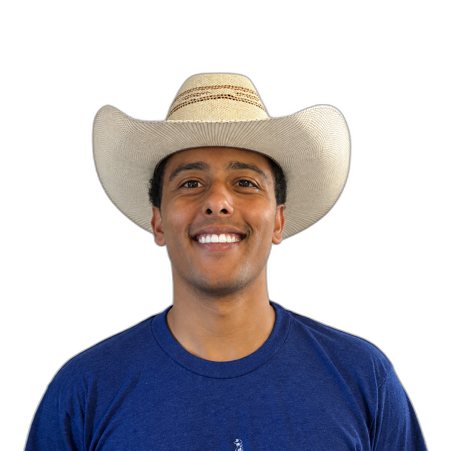

Excited to share that I've joined Cowboy Ventures, and relocated to the Bay Area from NYC.
Cowboy is a firm built to go deep: people first, fewer companies, real partnership, and the team-first instinct where you don't get one of us, you get all of us. That’s the job I wanted, because going deep is the only way I know how to work.
I grew up playing tennis and spent an unreasonable amount of time on racquet strings, on how gauge and tension change a ball's launch trajectory. In college I studied Math and Econ, where the fun was seeing a binomial distribution produce the whole law of supply and demand. Most recently, it was sitting next to founders at Company Ventures while the ground moved under all of us: RAG, longer context windows, tool calling maturing into MCP, open models closing on the frontier, browser and computer use. A product that was impossible in the spring shipped by the fall.
Venture rewards the same instinct. Where the world is going, how it gets there, and why people build what they build are the questions to ask. But picking is only half the job. Partnering with the entrepreneurs doing the building is the other half. Aileen and this team have spent years defining what great early-stage investing looks like, and I feel lucky to be part of it. Which brings me to where I am going deep now:
Models keep getting more capable, and we keep finding more to do with them. The labs building them will be enormous businesses that Cowboy would love to invest in. But raw capability isn't the product. The product is capability turned into work someone will rely on, deployed in a real domain and trusted to run, and there's a persistent gap between what a model can do and what it gets trusted to do. That gap is never one thing. Sometimes it's under-harnessing, where context engineering or post-training would get a step change. Sometimes it's the last mile, where the model works, and the workflow around it doesn't. Sometimes it's trust, which enterprises extend slowly and revoke fast.
Closing that gap is where value accrues, and it happens in two places that are really one bet seen from two sides: the application layer, where a founder closes their domain's version of the gap, and the infrastructure that powers it. I’m investing behind five key themes:
Enterprise software used to sell you a place to store what already happened, and charge you per seat to look at it; people did the actual work around it. That's breaking in two directions.
AI-native services: As software and robotics can replace the work of humans, there is an opportunity to sell outcomes over the tool that produces them. I have invested in a few at Company (Thunder, Formulary, Prosper, Markups) and am picking up the work Cowboy has already done (Petual, Revin, etc.)
Agentic Software: As agents generate, store, and act on data across legacy systems, they create a new operating memory. This operating memory becomes a new record system and the starting point for new agentic actions. Standard Kernel, Arcol, and Mutiny in the Cowboy portfolio, along with Noetica, Didero, and Flora from the Company portfolio, are examples of companies I get excited about.
Healthcare is the rare product everyone agrees costs too much, with no one person in charge of the price. For the first time, healthcare is leading the pack in technology adoption. AI pressures costs from two directions.
AI-native care delivery: Agents are becoming increasingly capable of reasoning through patient records and treatment guidelines to provide accurate diagnoses. In many cases, AI is already a viable replacement for low- to mid-acuity care. I think with improved payment rails and patient-safety guardrails, we will see new care-delivery businesses emerge across this category.
Lowering the administrative cost of care: A huge share of the cost is coordination: people on phones, prior authorization, and even faxes. Agents are unreasonably good at exactly that. Venture-backed businesses have already started tackling RCM, scheduling, and other low-hanging-fruit use cases. I’m looking for founders tackling more complex operational challenges.
For decades, the deal was learning the computer's language. Menus, buttons, where to click… but it never learned ours. That's changing: the interface can meet you where you are. There are two genres here.
Voice: Voice has become a more reliable modality for using systems and taking action. Infrastructure improvements in latency, context handling, interruption, and turn-taking have enabled voice applications to take on more complex tasks. Large companies will be built across both the infrastructure and applications of voice AI.
Generative UI/UX: The age of static user experiences is over. Instead of screens someone drew in advance, the interface assembles itself around your intent or action. I believe that user experiences that mix static and generative elements will define the next generation of applications, but the infrastructure to accomplish this is quite nascent.
AI applications in finance are more reliant on trust than in most industries. Financial data has been numbers in a database for generations; the binding constraints are tribal knowledge, regulation, fraud, and the fact that being confidently wrong is expensive. I split my attention two ways.
Financial institution infrastructure: The analysis, research, underwriting, and compliance work that happens inside banks, funds, and lenders. Eisen in the Cowboy portfolio and Rogo, Kepler, and Constellation in the Company portfolio are examples of companies I have gotten excited about.
Consumer financial infrastructure: AI’s ability to string together vast amounts of context can drastically reduce the amount of capital an individual needs to get expert financial insights and outcomes. A few categories that are interesting are consumer credit, wealth management, and tax/estate planning.
The least visible layer ties the rest together: post-training and reinforcement-learning environments, evals and observability, orchestration, and the plumbing beneath agents and tool calls are all categories we are actively investing in. One thesis we find interesting:
Verticalized Post-Training, Compute, and Infra: The proprietary data, hard environments, evals, and compute stack required to improve generalized model capability and fine-tune models for task-specific work makes whoever owns them a dependency for both the labs and the enterprises buying from them. Cowboy is an investor in Fluid Concepts and Contra Labs and we're excited to build out this part of the portfolio.
That’s the map. Five themes, because narrowing is a skill I'm still working on. If you're building, investing, or just brainstorming in these spaces, I'd love to hear from you: jonny@cowboy.vc
Lorem ipsum dolor sit amet, consectetur adipiscing elit, sed do eiusmod tempor incididunt ut labore et dolore magna aliqua. Ut enim ad minim veniam, quis nostrud exercitation ullamco laboris nisi ut aliquip ex ea commodo consequat. Duis aute irure dolor in reprehenderit in voluptate velit esse cillum dolore eu fugiat nulla pariatur.
Block quote
Ordered list
Unordered list
Bold text
Emphasis
Superscript
Subscrinolkm;pvdidunt ut labore et dolore magna aliqua. Ut enim ad minim veniam, quis nostrud exercitation ullamco laboris nisi ut aliquip ex ea commodo consequat. Duis aute irure dolor in represdasc

